New TCG Sets & Releases: What’s Out Right Now
Last reviewed:
Quick answer
Somewhere across the six major TCGs, the newest set changes every few weeks — so the auto-updating grid below, which refreshes from our set data, and each publisher’s official release page are the right places to check first. As of the July 2026 review, Pokémon is in its Mega Evolution era, One Piece is deep into its OP-numbered boosters, and every major game ships new sets roughly every two to four months. Recency is information, not a reason to rush: launch prices usually carry a hype premium that later restocks erode, and the odds inside the packs never change.
What’s newest right now
Any sentence that names “the newest set” starts aging the moment it is written — across six games on staggered schedules, something new arrives most months, and a page like this one is reviewed on a cycle rather than rewritten daily. So this pillar is built to stay honest about that: the grid directly below pulls the newest set per game straight from our set data, updating as coverage lands, and the publishers’ official release pages remain the only sources that are always current on day one. What the prose adds is the part that does not go stale: how each game’s release rhythm works, what “newest” actually means when three different sets can claim the title, whether buying at release is ever the smart move, and how our own coverage keeps up. For the very latest name, trust the grid and the official pages over any paragraph — including this one.
The newest set per game, from our data
Mega Evolution—Phantasmal Flames
Phantasmal Flames is the second main expansion of the Mega Evolution era, bringing Mega Evolution mechanics back to the TCG with Mega Charizard X ex as the marquee card. The set runs 94 main cards plus 36 secret rares, and chase interest centers on the special illustration rare Mega ex tiers.
Carrying On His Will
Carrying On His Will (OP-13) is the One Piece Card Game's third-anniversary booster, themed around inherited will with the Luffy–Ace–Sabo brotherhood at its center and manga-style Luffy cards leading chase interest. It follows the standard English format of 12-card packs and 24-pack booster boxes.

Avatar: The Last Airbender
The Avatar: The Last Airbender Universes Beyond set adapts the animated series into a standard-legal Magic release, with the four nations and bending mechanics woven into the design. Premium Aang treatments — including Avatar State art — lead chase interest, concentrated in Collector Boosters. As a recent release, verify current product details on official pages.
Alliance Insight
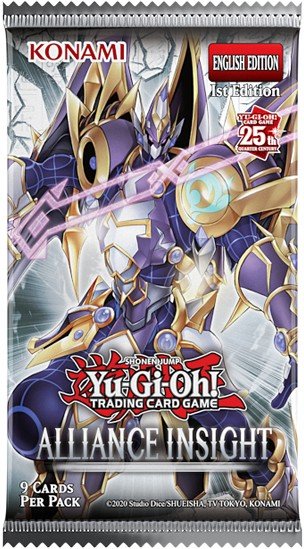
Alliance Insight is a 100-card core Yu-Gi-Oh! booster mixing new archetype support with nostalgia plays — including Dark Magician Girl the Magician's Apprentice, a modern take on the classic monster. As with other recent core sets, the EN000 slot — Dragon Master Lords — is printed only as a Quarter Century Secret Rare, making it the headline pull of the set.
Fabled
Fabled is Lorcana's ninth set and its biggest demand spike since launch — sealed has traded far above MSRP, with even base Legendary singles like Dumbo - Ninth Wonder of the Universe carrying real value. Above the Enchanted tier, the set is reported to add an ultra-rare premium tier of iconic characters; verify current rarity details on official Ravensburger pages. Price sealed against singles carefully here — the market moves quickly on this set.
Legends of the Force
Legends of the Force is Star Wars Unlimited's fifth set, gathering Jedi and Sith from across every era — Yoda, Vader, Anakin, Qui-Gon Jinn and Darth Revan among them. Its chase tier is premium foil and showcase-tier variant prints (the high card numbers denote variants, not the standard set), led by Yoda, My Ally is the Force and Darth Vader, Twilight of the Apprentice. As a recent release, verify current product details on official pages.
New Adventure
New Adventure is a later Fusion World booster set for the Dragon Ball Super Card Game, refreshing the format with new characters and support. Packs hold 12 random cards, with foil Super Rares, over-numbered Secret Rares and signed Special Rares as the headline pulls — none guaranteed in any pack. TCGplayer catalogs this set as FB05; verify the code and card list on the official set page before citing them.
Goddess of Victory: Nikke
Goddess of Victory: Nikke is a Union Arena crossover set built around the Nikke franchise, bringing its characters into the Bandai-published Union Arena format. It is a preorder release, and Union Arena pack and box configurations vary by set, so check the listing for exact card and pack counts. Contents are random, with Super Rares and premium Union Rares as the chase tiers and no card guaranteed in any pack; anime and character-card collectors are the core audience.
Eternal Nexus
Eternal Nexus (GD05) is a later Gundam Card Game booster set expanding the roster with new Mobile Suits and pilots. It is treated here as a preorder release; pack size and box pack counts vary, so check the listing and the official set page for exact figures. Packs are random, with foil Super Rares and alternate-art Secret Rares as the chase tiers and no guaranteed card.
Release Special Booster 2.0
Release Special Booster 2.0 is a reprint-focused Digimon Card Game set that reintroduces earlier cards and popular rares in a single booster. Packs hold 12 random cards, with foil Super Rares, over-numbered Secret Rares and alternate-art rares as the headline pulls — none guaranteed in any pack. Because it is a special reprint set, verify the exact card list and any new treatments on the official Digimon Card Game site.
Origins
Origins is the launch set for Riftbound: League of Legends Trading Card Game, the first TCG from Riot Games, built around League of Legends champions and the Rift. As the debut set it establishes the Common through Epic tiers, with Showcase and over-numbered treatments as the premium chase and no card guaranteed in any pack. Alongside boosters, Origins ships preconstructed Champion Decks in Jinx, Viktor and Lee Sin variants; verify the current pack size and box configuration on the official Riftbound site.
“Newest” splits into three different sets more often than not. There is the newest announced set, which dominates conversation months before anyone can open it; the newest released set, which is what the grid above tracks; and the newest set you can walk in and buy at retail price, which is frequently one release older than the headlines. The gap matters because each stage has its own economics: hype and preorder premiums peak around announcement and launch, supply peaks a few weeks after release when restocks land, and the friendliest prices for openers usually arrive once a set stops being the news. When someone asks what the newest set is, the most useful answer is usually the released-and-restocked one — the newest set that is done being scarce.
Warning
Set names and dates in the prose and tables on this page reflect English (international) releases as of the July 2026 review; regional schedules differ, and newer sets will have shipped since. Always verify current releases on each publisher’s official site before buying.
How release cadences work, game by game
Each publisher runs its own rhythm, and knowing the rhythm replaces most news-checking. Pokémon is the fastest of the majors: a main or special set roughly every two months, with special sets slotting between main expansions in different product formats. One Piece ships numbered OP boosters on a roughly quarterly beat, padded with extra boosters and theme boosters between them. Magic’s tentpole Standard sets arrive every few months, interleaved with crossover and supplemental products, so the true release calendar is denser than the Standard rhythm suggests. Lorcana runs approximately quarterly sets, Star Wars Unlimited ships two to three sets a year, and Yu-Gi-Oh! puts out quarterly core boosters wrapped in a thick schedule of structure decks, tins, and side sets. None of these cadences is a secret — every publisher posts a release page — which is exactly why urgency around any single launch deserves skepticism.
| Game | Typical cadence | What a typical year adds | Day-one source |
|---|---|---|---|
| Pokémon | New set roughly every 2 months | 3–4 main expansions + special sets | Official Pokémon TCG site |
| One Piece | Quarterly-ish numbered boosters | 3–4 OP boosters + extra/theme boosters | Official Bandai One Piece TCG site |
| Magic | Tentpole sets every few months | 4+ major sets + crossover and supplemental products | Official Wizards of the Coast site |
| Yu-Gi-Oh! | Quarterly core boosters | 4 core sets + structure decks, tins, side sets | Official Konami site |
| Lorcana | Roughly quarterly | Around 4 sets | Official Disney Lorcana site |
| Star Wars Unlimited | 2–3 sets per year | 2–3 sets + starter products | Official Star Wars: Unlimited site |
Two wrinkles complicate the clean rows above. First, the schedules are staggered, so the hobby-wide “newest set” changes far more often than any single game’s cadence — a release lands somewhere most months, which is why an auto-updating grid beats a written list. Second, regional timing: Japanese Pokémon and One Piece sets typically release months before their English counterparts, so “new set” headlines from Japan describe products that will not reach international shelves for a while. When a set seems to be both out and not out, the region is almost always the explanation — and the English release date is the one that matters for the products this site covers.
The buyer-side implication of every row in that table is the same: there is always another set coming. A cadence is the opposite of a last chance — whatever this month’s release is, the next one is already scheduled, and the one after that is already designed. That turns recency from pressure into plain information. Missing a launch weekend costs nothing except waiting; catching one costs whatever the hype premium happens to be that week. The collectors who do best with new releases treat the calendar as a conveyor belt they can step onto at any point, not a series of closing doors. It also reframes preview season: spoilers and announcements are entertainment about future products, not deadlines about current ones, and reading them that way costs nothing.
Where each game is right now
For orientation, here is the one-line state of each game as of the July 2026 review — with the standing caveat that this table ages by design, and the grid above plus the official pages outrank it the moment it does. The “newest tracked” column names the most recent set with full TCG Pax coverage, which can trail the true newest release while a set’s pages move through our pipeline; the era column describes the stretch each game is in, not a specific latest product.
| Game | Where the game is | Newest set with full TCG Pax coverage |
|---|---|---|
| Pokémon | Mega Evolution era (opened Sep 2025); new sets every ~2 months | Mega Evolution—Phantasmal Flames |
| One Piece | Deep in the OP-10-plus stretch of numbered boosters | Carrying On His Will (OP-13) |
| Magic | Post–Edge of Eternities Standard, with a heavy crossover cadence | Avatar: The Last Airbender |
| Yu-Gi-Oh! | Quarterly core boosters; Quarter Century Secret Rares remain the top chase | Alliance Insight |
| Lorcana | Now into double-digit set numbering | Fabled (set 9) |
| Star Wars Unlimited | At 2–3 sets a year | Legends of the Force |
Estimates, not guarantees
The “where the game is” column is a dated editorial snapshot, and the coverage column reflects our pipeline, not the market. Newer sets than these exist or will shortly — check the auto-updating grid above and the official release pages before treating any row as current.
Era and numbering labels are worth a moment, because they do real work for buyers beyond trivia. In Pokémon, the era names the rarity system you will open and shapes which product formats exist — Mega Evolution sets carry the Illustration Rare structure forward, and the era’s special sets follow the familiar no-booster-box pattern. In One Piece, the OP number is effectively a freshness stamp: low numbers mean older print waves priced by the secondary market, high numbers mean retail availability. Lorcana’s set count tells you how deep the catalog behind the newest release runs, and Star Wars Unlimited’s single-digit set count says the whole game is still young enough to catch up on from the beginning. Our Pokémon sets-in-order pillar walks that game’s full timeline; here the point is narrower — a “current era” line is orientation for reading listings and set codes, not a claim about what shipped this week.
Recent sets we cover in depth
Mega Evolution—Phantasmal Flames
Phantasmal Flames is the second main expansion of the Mega Evolution era, bringing Mega Evolution mechanics back to the TCG with Mega Charizard X ex as the marquee card. The set runs 94 main cards plus 36 secret rares, and chase interest centers on the special illustration rare Mega ex tiers.

Mega Evolution
Mega Evolution is the base set of the Mega Evolution era, which brought Mega Evolution mechanics back to the TCG in September 2025 while continuing the Illustration Rare and Special Illustration Rare structure from Scarlet & Violet. Chase interest centers on the gold-etched Mega Hyper Rare prints of Mega Lucario ex and Mega Gardevoir ex, which sit just above the same cards’ Special Illustration Rare treatments. It shipped in the full standard product range, including 36-pack booster boxes, and the era continued with Phantasmal Flames (ME02) in November 2025.
A Fist of Divine Speed
A Fist of Divine Speed (OP-11) headlines a manga-style Monkey.D.Luffy secret rare as its top chase. The set also carries premium SP reprint inserts of older chase cards — including versions of the OP05-119 Luffy — at very long odds, so a small number of pulls from these boosters carry values far above anything printed with an OP11 number. Standard English format: 12-card packs, 24-pack booster boxes.
Archazia's Island
Archazia's Island is Lorcana's seventh set, released in March 2025 with supply comfortably meeting demand — sealed generally sits near retail. Its Enchanted tier extends beyond characters to items and actions, with the Devil's Eye Diamond Enchanted among the set's talked-about pulls, and the Illumineer's Trove returns as the accessory-plus-boosters bundle. Enchanted odds remain long by community observation, so open for fun, not expectation.

Black Bolt
Black Bolt is the Zekrom-themed half of a pair of special sets celebrating the Unova region, released on the same day as its Reshiram-themed sister set, White Flare. Its secret list is as large as its base list — 86 cards plus 86 secret rares, most of them Illustration Rares — and chase interest concentrates on the Black White Rare Zekrom ex and a secret-rare Victini, the two priciest cards in the set by our dated snapshots. As a special set it was not sold in standard 36-pack booster boxes; packs ship in booster bundles, Elite Trainer Boxes and collection products.
Twilight of the Republic
Twilight of the Republic is Star Wars Unlimited's third set, set in the Clone Wars — Anakin, Yoda, clone troopers, battle droids and the slow slide toward the Empire. Its premier chase is the high-number variant Yoda, Sensing Darkness, with other prequel-era leaders close behind at very long observed odds. Like every SWU set it is built play-first: 16-card packs feed draft and sealed as much as collections.
Should you buy at release? The honest answer
Launch week is when a set costs the most to open. Day-one demand meets first-wave supply, hyped sets trade above list at exactly the moment excitement peaks, and every one of those marked-up packs contains the same random contents it will contain a month later. Restocks are the quiet counterweight: for most sets, second and third waves land within weeks, shelves refill, and street prices settle back toward list — the pattern repeats often enough that waiting out the first wave is the closest thing sealed buying has to a reliable discount. What launch-week money actually buys is time and participation: opening the new set while it is the conversation, playing prerelease weekend, being early. Those are real things, and if they are worth the premium to you, buy them knowingly as entertainment spending. What the premium never buys is better packs.
Preorders deserve the same honesty. Preordering at list price from a reputable retailer is a reasonable hedge on a set you were going to buy anyway: if launch demand spikes, you locked list, and the risks are the mundane ones of allocation cuts and shifting ship dates. Preordering above list from resellers is where the math turns against you — you are paying the hype premium in advance, before restocks have had their say, and hyped sets have a long record of costing less a few weeks after launch than the day before it. Chase-card singles run on the same clock in reverse: a set’s top singles are usually most expensive at launch, when almost none have been pulled, and drift down as openings accumulate supply. The patient buyer often wins twice — cheaper packs after the restock, cheaper singles after the market absorbs the pulls.
One more launch-week phrase deserves translation: “sold out.” A set selling out at launch rarely means it is gone — it means the first print wave sold, and for current sets publishers routinely print more. Genuinely constrained products exist, but they are the exception, and even the famously scarce special sets have typically seen restock waves months after their headlines. A dated review like this one cannot tell you today’s stock at any store; what it can tell you is that “sold out” is usually a timestamp, not a verdict, and that paying a resale markup in the gap between waves is a choice restocks tend to punish.
Warning
A new set is not a last chance. Cadences mean the next release is already scheduled, restocks mean launch scarcity is usually temporary, and no countdown belongs in a buying decision. If a listing is selling urgency, it is selling the markup — the packs are random at every price.
Run your own numbers
Enter any estimated pull rate and pack count to see the statistical chance of at least one hit — and how many packs a 50%, 75% or 90% chance needs. Estimates only; packs stay random.
Open the pack odds calculatorHow TCG Pax keeps release coverage current
Our freshness commitment is a pipeline, stated plainly: when a new set releases, it gets a set page, a card list, a chase-card rundown, and product pages for its packs, boxes, and bundles, with price snapshots that are dated rather than passed off as live. Every page shows its last-review date, pull-rate figures carry sample sizes and confidence labels, and placeholder data is flagged as demo data rather than dressed up as evidence. The latest-sets grid on this page updates from that data automatically, which is why it outranks the prose around it. When coverage lags a release — and in a six-game hobby it sometimes will — the honest state is a set missing from our data for a few days, not a fake page pretending to knowledge we do not have yet.
If this page and reality disagree, reality wins: trust the publisher’s release page, and tell us — coverage gets reviewed and corrected on exactly that kind of signal. A dated page that admits its date is more useful than a fresh-looking page with no date at all, and that is the trade we have chosen everywhere on this site. It is also why every number here — dates, cadences, era labels — travels with the review date rather than an implication of nowness: the honest unit of freshness for prose is the dated revision, and the honest unit for data is the automated grid.
Tracking new releases without the hype
- Bookmark each publisher’s official release page — it is the only day-one source, and every one of them is free.
- Read “last chance” and countdown marketing as price signals, not information: urgency language correlates with markup, not with real scarcity.
- Decide your budget for a set before preorders open, and let the number — not launch-week coverage — decide what you buy.
- Let restocks come to you: checking prices a few weeks after launch is the single most reliable way to pay less for identical packs.
- Price a set’s chase singles at launch before opening anything — they are usually at their peak, and the comparison keeps the sealed math honest.
That is the whole discipline: treat recency as information about what exists, never as pressure about what to do. The newest set is a fact the grid above will keep current; whether to buy it is a decision the cadence, the restock pattern, and the singles market should inform at your pace. New sets will keep arriving on schedule whether you rush or not — which is precisely why you never need to.