Booster Pack Odds & Pull Rates, Explained
Last reviewed:
Quick answer
Pull rates are observed frequencies from tracked pack openings — estimates, not promises, and almost never official numbers from publishers. The chance of at least one hit over n packs is 1 − (1 − p)^n, which means a 1-in-100 card over 100 packs is only about a 63% chance, not a certainty. Stats set expectations; they never change randomness or guarantee a pull.
What pull rates actually are
A pull rate is a simple ratio: out of some number of packs that people opened and recorded, how many contained a card of a given rarity or a specific chase card. When you read that a Special Illustration Rare appears “about 1 in 60 packs,” that is shorthand for “in the openings someone tracked, one appeared per 60 packs on average.” It is a measurement of the past, not a promise about your pack. This distinction sounds pedantic and is actually the single most important idea in this entire topic: a pull rate describes the frequency in a sample, and your packs are new random draws that owe that sample nothing. Good pull-rate data is genuinely useful — it tells you what kind of expectations are reasonable — but the moment a number is read as a guarantee, it starts costing people money. It also explains why two honest sources can quote different rates for the same card: different samples, different print waves, different recording standards. Disagreement between datasets is not a scandal; it is what sampling variation looks like from the outside.
Estimates, not guarantees
Pull statistics are estimates based on available data and may vary. Opening packs is random. No pack, box, or sealed product guarantees a specific card unless the product explicitly states it. Stats are estimates, not guarantees.
Official odds vs observed data
Here is a fact that surprises most collectors: the publishers of the major TCGs generally do not publish pull odds at all. There are partial exceptions — some products in some regions print approximate rarity rates on the packaging, and Magic has published slot structures for certain booster types that describe what kinds of cards occupy each slot — but for the headline questions people actually ask, like the odds of a specific alternate-art chase card, there is usually no official number anywhere. Anyone who quotes exact odds as if they were printed on the box is either citing observed data without saying so, or making it up. This is not necessarily publishers being cagey — odds are a moving target, since print runs, wave differences, and regional assembly all make a single global number harder to stand behind than it sounds.
Observed data fills that gap. Content creators who record every pack of large openings, community spreadsheets that aggregate thousands of submitted packs, and marketplace-scale datasets together form the real evidence base for every pull-rate figure you have ever seen. This data is valuable and worth taking seriously — with two caveats attached permanently. First, samples can be biased: box openings from one print wave may differ from another, and self-reported data over-represents exciting results. Second, precision is limited by sample size, which deserves its own section, because it is where most pull-rate claims quietly fall apart.
Sample size: why 600 packs beats 60
Suppose a card truly appears in 1 of every 80 packs. Open 60 packs and the most likely outcomes are zero or one copy — and either result would suggest a wildly wrong rate (0%, or 1 in 60). Open 600 packs and you would expect around seven or eight copies, enough that your observed rate lands meaningfully close to the truth. Open 6,000 and the estimate tightens further. This is why a YouTube video of one booster box “proving” a set has terrible pull rates proves nothing at all, and why we attach sample sizes and confidence labels to every dataset we publish. The smaller the sample, the wider the honest error bars — and for the very rarest cards, even a thousand packs may contain only a handful of hits. The working rule: judge a dataset by its expected hits, not its pack count. A thousand packs sounds authoritative, but for a 1-in-500 card it contains about two expected hits — barely better than anecdote.
| Packs opened | Expected hits | How reliable is the observed rate? |
|---|---|---|
| 60 (about 2 boxes) | ≈ 0–1 | Very low — zero hits is completely normal; the estimate is mostly noise |
| 600 | ≈ 7–8 | Moderate — the rate is in the right neighborhood but still swings noticeably |
| 6,000 | ≈ 75 | Good — the observed rate is usually within a tight range of the true rate |
| 60,000 | ≈ 750 | Strong — precise for common tiers, though rare-card estimates still carry error |
The math: from per-pack odds to real chances
One formula does almost all the useful work in this hobby. If a card appears with probability p in each pack, the chance of pulling at least one across n packs is 1 − (1 − p)^n. Each pack is an independent draw, so you multiply the miss chance (1 − p) across all n packs to get the probability of missing every time, then subtract from one. The formula’s message is counterintuitive and important: your chances do not stack the way instinct suggests. Buying 100 packs at 1-in-100 odds does not make the pull certain — it makes it likely-ish, and the gap between those two words is where budgets go to die. The exponent is doing the damage: every additional pack multiplies your miss chance by (1 − p), a number only barely below one, so misses compound far more stubbornly than intuition expects.
Work the example: p = 1/100, n = 100 packs. The miss chance per pack is 0.99, and 0.99 raised to the 100th power is about 0.366. So after opening 100 packs — an entire booster box and then some — the chance you found at least one copy is 1 − 0.366 ≈ 63%. More than a third of people who buy “enough packs to hit the odds” miss anyway, and that is the expected outcome, not bad luck. To reach a 95% chance of at least one copy you would need around 300 packs, and even then, 1 in 20 hunters comes up empty. Run the numbers on any card and price the equivalent number of packs against the single before you decide to chase.
Warning
Stats do not change randomness. A 50% — or even 95% — statistical chance does not guarantee a pull, and no quantity of packs makes a specific card certain. Stats are estimates, not guarantees; budget for the miss, because the miss is common.
Run your own numbers
Enter any estimated pull rate and pack count to see the statistical chance of at least one hit — and how many packs a 50%, 75% or 90% chance needs. Estimates only; packs stay random.
Open the pack odds calculatorWhy “a box guarantees X” is usually false
Listings and videos love the phrase “every box guarantees” — a hit of some rarity, a full-art trainer, a secret rare. For most products in most games, no such printed commitment exists. What actually happens is that observed box-level frequencies get rounded up into guarantee language: if tracked boxes of a Yu-Gi-Oh! set average about one Quarter Century Secret Rare each, sellers start writing “1 QCSR per box” as if it were policy. Averages have variance — some boxes have two, some have zero — and the zero boxes are exactly as consistent with the average as the lucky ones. A few product lines do have defined slot structures (Magic Collector Boosters describe what card types fill each slot, and some fixed products state their contents), and where a publisher genuinely states something, we say so and label it official. Everywhere else, treat “guaranteed per box” as marketing translation of an observed average, and expect exceptions. The honest reframe is to think in per-box averages with variance, and to price boxes accordingly: a box is a bulk discount on random packs, not a contract for specific contents.
The odds landscape, game by game
With all the caveats above firmly attached, here is the shape of top-rarity odds across the major games as community openings currently suggest. Every figure below is a community-observed estimate from limited samples — none of it is official, all of it varies by set, and newer sets can behave differently from the ones that produced these numbers. Use the table to compare the shape of chases across games — which tiers are box-level hunts and which are case-level — rather than to plan a specific chase, which should always run through current set-specific data.
| Game | Rarity tier | Community-observed estimate | Notes |
|---|---|---|---|
| Pokémon | Illustration Rare (IR) | ≈ 1 in 6–8 packs | Varies by set; multiple IRs per booster box is typical |
| Pokémon | Special Illustration Rare (SIR) | ≈ 1 in 40–90 packs | Specific SIRs are rarer than the tier overall |
| One Piece | Manga rare | Often multiple boxes per copy | Among the longest chases in the hobby; varies sharply by set |
| Lorcana | Enchanted | ≈ 1 in 80–100 packs | Roughly one per 3–4 boxes observed |
| Yu-Gi-Oh! | Quarter Century Secret Rare | ≈ 1 per 24-pack box | Observed average, not a printed rule; boxes with zero exist |
| Magic | Collector Booster premium slots | Slot structure published; treatments vary | Slots define card types, not which card — serialized cards are far rarer |
The gambler’s fallacy and other expensive myths
The gambler’s fallacy is the belief that randomness keeps score — that after twenty packs without a hit, the next pack is “due.” It is not. Packs are independent draws; the cardboard has no memory, and your odds on pack twenty-one are identical to what they were on pack one. This fallacy is the engine of chasing losses: each miss feels like it raises the next pack’s odds, so people keep buying past any budget they set. The reverse superstition — that a hot box will stay hot — is equally false. Internalizing independence is worth more than memorizing any pull-rate table on this site. If you take one sentence from this page into a card shop, take this one: the next pack does not know what the last pack did.
Two more myths deserve a direct debunking. “Short packs” or “dead packs” — the claim that certain pack positions in a box never contain hits, or that hits follow a predictable box pattern — does not survive contact with large observed datasets; hit positions look random across tracked boxes, and mapping techniques that circulate online are pattern-matching on anecdotes. And the idea that packs from Elite Trainer Boxes, tins, or bundles carry different odds than loose packs has no official evidence behind it: regular booster packs from different sealed products should not be presented as having special odds unless a publisher actually says so. A booster pack is random, whatever wrapper it arrived in.
Warning
Never buy loose packs that may have been weighed or resealed. Weighing was used on older products to detect holo cards, and although modern packs are designed to defeat it, loose-pack resellers remain a known scam channel. Buy sealed products from reputable sellers.
How TCG Pax pull-rate data works
Every pull-rate figure on this site belongs to a named dataset, and every dataset carries the metadata you need to judge it: the sample size in packs and boxes, the collection method (official statement, marketplace-observed, community-observed, creator-observed, or internal), when it was collected and last reviewed, and an explicit confidence level. Where we are still building coverage, some datasets are marked as demo data — placeholders that are flagged as such and are never presented as real evidence. We would rather show you a low-confidence label than a confident-sounding number with nothing behind it. When a figure on this site disagrees with a bigger or newer sample elsewhere, trust the bigger sample, and tell us — datasets are reviewed and replaced as better data appears. Sample sizes, methods, and confidence labels are shown on the dataset pages themselves, next to every figure they support, so you never have to take a bare percentage on faith.
Packs with tracked pull-rate data
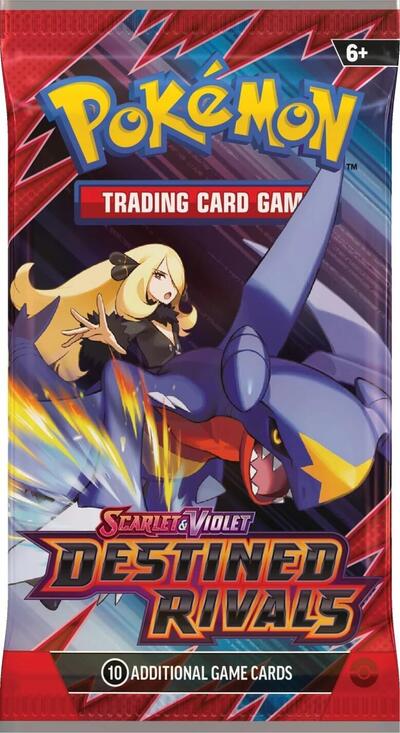
Destined Rivals Booster Pack
A single 10-card Destined Rivals booster with random contents. Team Rocket Special Illustration Rares are the estimated top pulls, but no specific card is guaranteed in any pack. A fine impulse open; for a specific card, compare the cost of the single first.
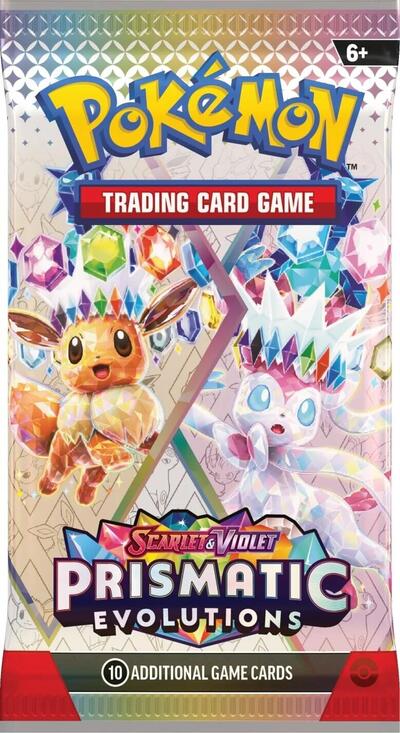
Prismatic Evolutions Booster Pack
A single 10-card Prismatic Evolutions pack with random contents. This special set has no standard booster boxes, so loose packs mostly come from broken-down ETBs and bundles and often trade above MSRP. Eeveelution SIR odds are long — estimated, not guaranteed — so price singles before chasing.
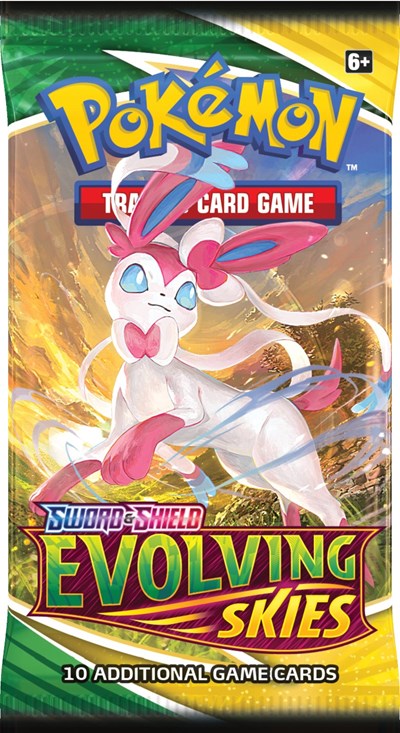
Evolving Skies Booster Pack
A single 10-card pack from the 2021 Eeveelution alt-art set, now a secondary-market item trading far above original MSRP. Alt-art VMAX odds were long even at release; a loose pack is a lottery ticket, not a value buy. Buy only from reputable sellers — this set is a known target for resealed and weighed packs.
Using odds responsibly
Odds knowledge should make you calmer, not braver. The healthy uses are all about expectation-setting: knowing that a box with zero big hits is normal, that a chase card usually costs less as a single than as an expected number of packs, and that a budget set before opening is the only kind that works. The unhealthy use is treating the math as a system to beat — there is no system, because there is nothing to outsmart; every pack is the same fair draw. Open packs for the fun of opening and the breadth of a collection. If you need one specific card, compare the cost of the single before you buy a single pack. That comparison, made honestly, is the entire skill. And if opening has stopped feeling like entertainment and started feeling like recovery, that is the signal to stop — the cards will still exist as singles tomorrow.